
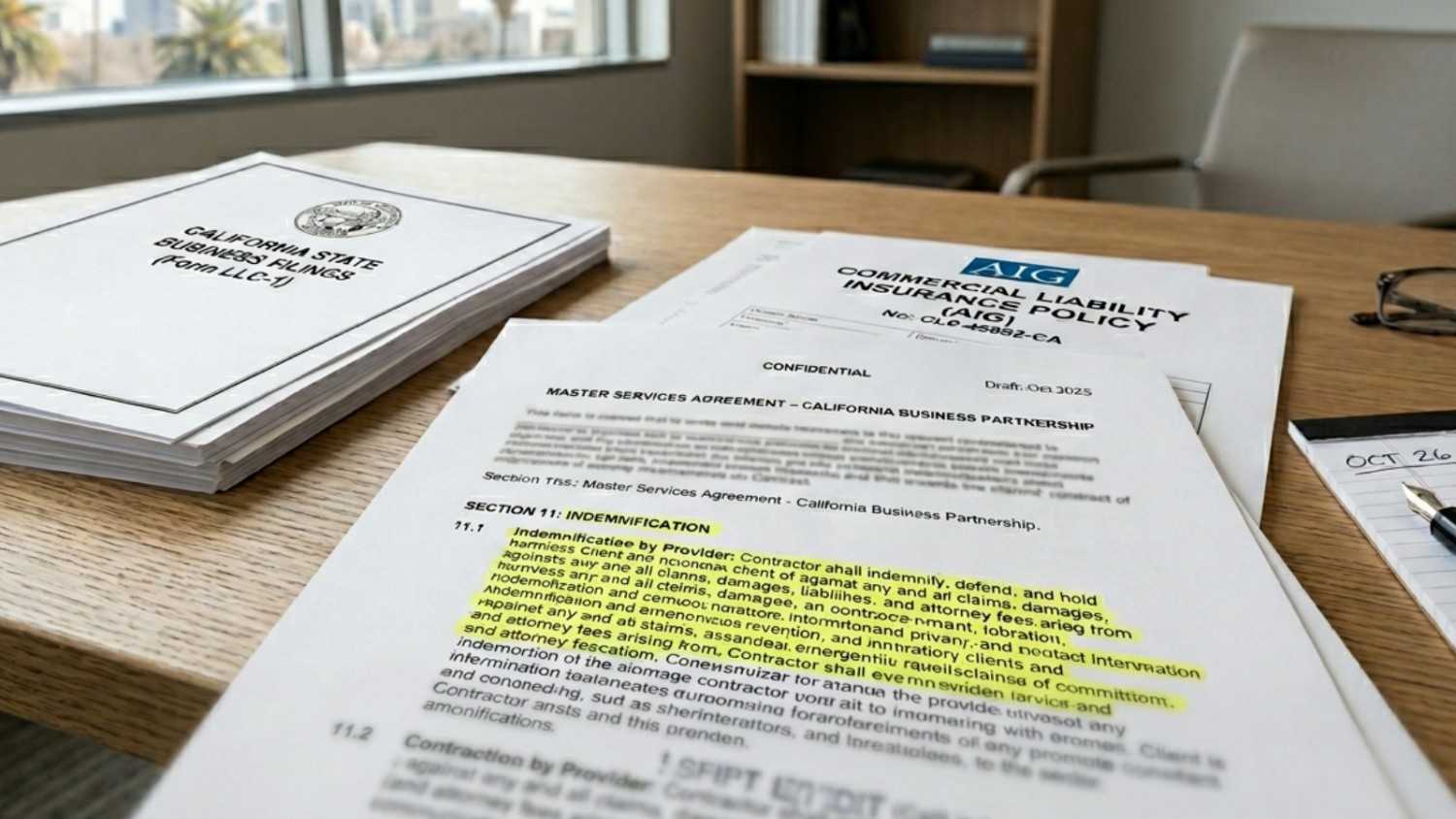
An indemnification clause determines how financial responsibility gets allocated when a contract-related claim surfaces. In California, those provisions carry more legal weight than many businesses realize. Courts scrutinize the wording closely, construction contracts face statutory limits that do not apply in every industry, and seemingly standard phrases can dramatically expand or narrow a party’s exposure. The clause also rarely operates in isolation. Insurance coverage, defense obligations, and the exact type of claim often shape the real-world outcome as much as the language of the business contract itself.
Some indemnity provisions hold up exactly as written. Others get narrowed by the courts, partially invalidated under California statutes, or create disputes over defense costs and fault allocation that neither side anticipated when the agreement was signed.
The Basic Mechanics of an Indemnity Clause
Indemnification is a contractual promise. One party (the indemnitor) agrees to cover specified losses the other party (the indemnitee) suffers if a defined event occurs. California Civil Code § 2772 captures the idea in statutory form: a contract to “save another from a legal consequence of the conduct of one of the parties, or of some other person.”
In commercial contracts, the triggering events typically include:
- Third-party lawsuits: A customer, employee, or bystander sues someone connected to the contract
- Property damage: Loss caused by the performance of the contract
- Personal injury claims: Injuries arising out of work performed under the agreement
- Intellectual property allegations: Patent, copyright, or trademark claims tied to goods or services delivered
Indemnity differs from a warranty (a promise that something is true) and a guarantee (a promise to perform if another party fails). A warranty creates a direct claim between the parties about a product or representation. A guarantee creates secondary liability for someone else’s performance. An indemnity allocates downstream financial risk, often arising from third-party events neither party can fully control.
California law also recognizes a separate doctrine of equitable indemnity, which courts apply between parties who share liability for the same harm even when no contract addresses it. The two doctrines operate on different theories: express contractual indemnity is governed by the parties’ written language, while equitable indemnity is a court-fashioned remedy based on fault allocation. This article focuses on express contractual indemnity in business agreements.
Read More: Ensure Your Business Has Legally Enforceable Contracts
How California Courts Read Indemnity Language
California does not impose a rigid statutory taxonomy on indemnity clauses. Practitioners and treatise writers commonly describe three drafting patterns as an analytical shorthand, but courts ultimately interpret the specific words used and apply the statutory framework that fits the contract type.
The three patterns appear constantly in commercial drafting:
- Broad indemnity language: Covers losses regardless of who caused them, including the indemnitee’s own fault
- Intermediate indemnity language: Covers losses unless the indemnitee was the sole cause
- Limited or comparative indemnity language: Allocates loss in proportion to each party’s fault, often signaled by phrases like “to the extent caused by”
Each pattern produces different enforceability outcomes depending on the contract type (especially construction), the precision of the wording, and the parties’ relative bargaining position.
Gross Negligence and Willful Misconduct
California public policy generally does not allow a party to contract away liability for its own gross negligence, fraud, or willful misconduct. (Cal. Civ. Code § 1668.) Indemnity clauses that attempt to reach those categories are typically unenforceable as to that portion of the obligation, though the remainder of the clause may survive if it can be severed.
Duty to Defend vs. Duty to Indemnify
One of the most consequential distinctions in California indemnity law is between the duty to defend and the duty to indemnify. The two are related but operate differently.
- Duty to indemnify: Pay covered losses after liability is established or settlement is reached
- Duty to defend: Provide and fund a legal defense once a covered claim is asserted, before liability is decided
Practical implications:
- A clause that says “defend, indemnify, and hold harmless” typically triggers both duties
Insurance, Additional Insureds, and Tender
In practice, indemnity clauses rarely operate in isolation. They work alongside insurance requirements and additional insured endorsements, and the interaction often matters more than the indemnity language itself.
Additional Insured Provisions
Many commercial contracts require one party to name the other as an additional insured under its liability policy. This creates direct rights against the insurer, independent of the contractual indemnity obligation. Additional insured status often produces faster, broader, and more reliable coverage than a contractual indemnity claim because the protected party can tender directly to the insurer.
Key drafting points:
- Scope of additional insured coverage: Often limited to liability arising out of the named insured’s operations
- Primary and non-contributory language: Determines whether the additional insured’s own policy contributes to defense and indemnity
- Policy limits and exclusions: The certificate of insurance is not the policy; the underlying policy controls
The Tender Process
When a third-party claim is filed, the indemnitee typically tenders the claim to the indemnitor and to any insurer providing additional insured coverage. The tender process raises several practical issues:
- Timing: A late tender can prejudice the indemnitor’s ability to investigate and control the defense
- Acceptance with a reservation of rights: An indemnitor or insurer may accept the defense while reserving the right to dispute coverage later
- Control of defense: Who selects counsel and makes settlement decisions is often contested
- Conflicts of interest: A reservation of rights may trigger the indemnitee’s right to independent counsel under California law
These mechanics determine the real-world value of an indemnity clause. A well-drafted indemnity provision paired with mismatched insurance often produces less protection than a modest indemnity provision backed by additional insured coverage.
Allocation Mechanics: “To the Extent” Language
Comparative indemnity language allocates loss in proportion to fault. The phrase “to the extent caused by” is common, but the operational mechanics depend on how the allocation is performed.
Issues that arise in allocation disputes:
- Comparative fault frameworks: California applies pure comparative fault, and indemnity allocation often references this framework
- Joint and several issues: When multiple parties contribute to a single harm, apportionment among them can become its own dispute
- Settlement allocation: When one party settles, allocating the settlement to specific theories or parties affects later indemnity claims
- Pre-judgment versus post-judgment apportionment: Some clauses defer the allocation question until after the underlying liability is resolved
Comparative language reduces the all-or-nothing risk of broader clauses, but it can shift disputes into the allocation phase, where the parties argue about percentages of fault rather than coverage in principle.
The intersection of AI tools and contract liability is a current area of attention. Assembly Bill 316, signed into law in October 2025 and codified at Civil Code § 1714.46, takes effect January 1, 2026. The statute changes one specific aspect of how AI-related civil claims can be defended, with downstream effects on how vendor contracts should be reviewed.
What AB 316 Actually Does
The statute provides that a defendant who developed, modified, or used an AI system cannot assert as a defense in a civil action that the AI autonomously caused the alleged harm.
The scope of the law is narrower than headlines suggest:
- Does not create strict liability: AI-related harm still requires proof of causation and the other elements of the underlying claim
- Does not change underlying principles: Tort and contract law continue to apply as before
- Does not address indemnification directly: The statute is silent on contractual risk allocation
- Does remove one defense theory: The “the AI acted on its own” argument is no longer available
- Does preserve other defenses: The defendant retains every other defense available under existing law
Why This Matters for Vendor Contracts
If a customer-facing dispute arises from AI output, the defending business cannot point at the AI and stop there. That risk has to live somewhere, and the contract is where it gets allocated.
Two practical consequences for businesses deploying third-party AI tools:
- Vendor indemnity becomes more important: With the autonomous-AI defense gone, the customer’s protection often depends on what the vendor agreed to cover
- Limitation-of-liability clauses need closer review: A vendor’s liability cap may leave the customer holding most of the exposure
Drafting Points for AI-Related Indemnity
Several issues recur in AI vendor agreements and deserve attention before signing:
- Scope of IP infringement coverage: Patent, copyright, and trademark claims tied to model outputs
- Treatment of training data claims: Whether the vendor indemnifies for third-party rights in training datasets
- Customer-generated outputs: How defense and indemnity obligations apply when the customer’s use produces the alleged harm
- Usage carve-outs: Conditions under which the vendor’s indemnity is voided (off-label use, modifications, prohibited inputs)
- Defense control: Whether the deploying business or the AI vendor controls defense strategy and settlement authority when the claim targets model outputs
When Legal Review of an Indemnification Clause May Be Worthwhile
Indemnification provisions reward careful reading. Many disputes that reach litigation involve clauses that were signed without close attention to defense obligations, insurance interactions, or carve-outs required by California statutes or public policy.
Situations where a legal review from a business attorney tends to produce real value:
- Vendor and supplier agreements with broad indemnity language
- Construction contracts (general or subcontractor side)
- Technology and AI vendor licenses with IP indemnity provisions
- Partnership, shareholder, and operating agreements
- High-value service contracts and commercial real estate transactions
Nick Heimlich Law represents businesses in San Jose and across the Bay Area in business litigation, including disputes involving indemnification provisions, breach of contract, and related claims.
The firm does not handle tenant-side residential disputes, small claims, contingency-based cases, personal injury, or criminal or immigration matters. The rate of legal services starts at $450 per hour with a one-hour minimum for consultations. To discuss a contract or dispute, contact the office online or call us at (408) 457-9364.
For Attorney’s confirmation.
Do you want to keep this as a full H2 section, turn it into a shorter mention (one H3 under “Common Issues” or “Drafting Examples”), or spin it into a separate post?
after i finish all edits you can look at this, I don’t really care about headings, only care about leaving out what I delete


