

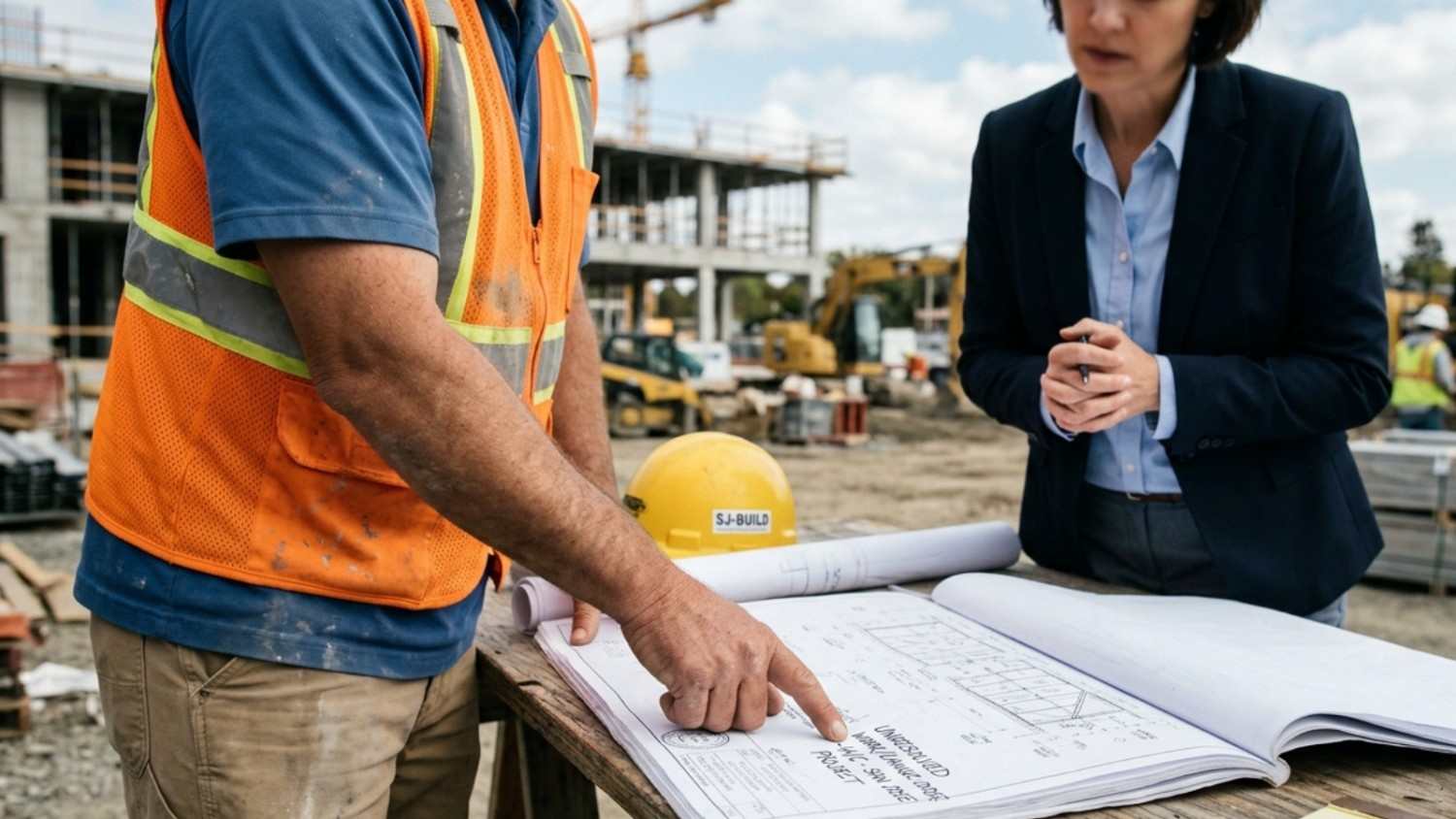
The most common construction dispute a San Jose business faces looks like this: a project is underway or complete, payment stops or defects surface, and the parties disagree about who owes what. California law gives you defined tools for that moment, including mechanics liens, stop payment notices, and breach of contract claims, and most disputes resolve through negotiation, mediation, or arbitration before anyone sees a courtroom.
Some of those rights are time-sensitive. A civil litigation attorney in San Jose can help you assess your situation, the statutes that govern it, and the approach that fits your goals before notice windows and limitation periods close.
What Are the Most Common Construction Disputes Between Businesses in San Jose?
Most business construction conflicts fall into six categories. Identifying yours matters, since the category determines which statute applies, which deadlines control, and which options make sense.
Payment Disputes, Mechanics Liens, and Stop Payment Notices
A contractor, subcontractor, or supplier who has not been paid may record a mechanics lien against the property. Most subcontractors and suppliers must first serve a preliminary notice, which should be filed within 20 days of first providing work, to preserve those rights. Owners, in turn, may dispute the amounts claimed or challenge liens they believe were recorded improperly.
Defective Work and Code Violations
Structural failures, water intrusion, and electrical or plumbing deficiencies are among the most frequent triggers for construction litigation. The analysis can differ for latent defects, which are hidden, versus patent defects, which are apparent on reasonable inspection.
On commercial projects, defect claims generally proceed under contract and common law theories such as negligence and breach of warranty.
Change Order and Scope-of-Work Disputes
Ambiguous change-order provisions, vague deliverable definitions, and poorly drafted termination clauses cause many of the conflicts that reach a construction contract lawyer. When a project shifts mid-build, the parties often disagree about what the revised price and schedule should be.
California courts typically start with the written agreement, but the analysis rarely ends there. All change orders must be in writing and signed before the work begins.. Understanding how courts treat a commercial contract breach helps you evaluate your baseline position before conduct during the project is factored in.
Contractor Abandonment and Project Delays
Abandonment sits at the extreme end of the delay spectrum. A contractor who walks off the job before substantial completion may face breach of contract liability, completion cost damages, and discipline through the Contractors State License Board. Owners dealing with abandonment should document the state of the work immediately and review the contract’s termination and cure provisions before hiring replacement labor. Photos should be taken of the property and all communications should be preserved. Issues should be put in writing to the contractor, even if the contractor is not responding.
Short of abandonment, unforeseen site conditions, design errors, material shortages, and labor gaps cause some delays. Courts and arbitrators may examine which party caused each delay, how delays overlapped as concurrent delay, and how each event affected the project’s critical path. Force majeure clauses can excuse some events entirely. A delay may be treated as excusable without damages, compensable with a monetary claim, or breach with broader liability.
Subcontractor and Supplier Conflicts
In general, the main contractor should always pay all the subcontractors they hire. Also, the property owner should ask to be advised of all subcontractors and their bids and proof of a lien release or payment with each subcontractor.
Contractor Licensing Disputes
Licensing is a category of its own in California. An unlicensed contractor generally cannot sue to collect payment for work requiring a license, and under Business and Professions Code Section 7031, a party who paid an unlicensed contractor may seek disgorgement of all amounts paid.
Licensing problems can surface mid-dispute and reshape the entire case, which is one reason businesses bring in a lawyer for a contractor dispute before positions are locked in. Verifying license status with the Contractors State License Board early, on either side of a conflict, is a practical first step before committing to a strategy.
Should You Send a Demand Letter or File a Lawsuit Immediately?
A demand letter is usually the right first move. It documents your position, starts a paper trail, opens the door to settlement, and costs a fraction of a filing. Many payment disputes resolve at this stage once the other side sees the claim laid out with supporting records.
Filing first makes sense in narrower situations. If a lien enforcement deadline or limitation period is about to run, filing preserves the claim. If the other party is insolvent, transferring assets, or has abandoned the project entirely, speed may matter more than diplomacy. If your contract requires arbitration, the equivalent step is initiating the arbitration rather than a court filing.
The decision turns on your deadlines, your evidence, and the other side’s conduct. An attorney can map those factors quickly and keep a demand letter that fails to produce a response from converting into a timely filing.
How Can You Resolve a Construction Dispute Without Going to Court?
Most San Jose construction disputes settle without a courtroom, and your contract may already dictate which route applies.
Negotiation and Direct Resolution
Many disputes end through direct communication between the parties. Informal resolution preserves working relationships and avoids the cost of formal proceedings.
Early attorney involvement can strengthen your negotiating position before positions harden. A clear record supports every later step, so learning how to document conversations to protect your contract rights pays off even if the matter settles quickly.
Mediation and Alternative Dispute Resolution
Mediation brings in a neutral third party who facilitates discussion and helps the parties find common ground. Any agreement remains voluntary, which gives both sides control over the result. Alternative dispute resolution is typically faster and less expensive than trial, and it suits parties who expect to keep doing business together.
On larger projects, the contract may go further and establish a dispute review board or a standing project neutral who addresses conflicts as construction proceeds, before they escalate.
Arbitration Clauses in Construction Contracts
Many construction contracts contain a mandatory arbitration clause, and that clause changes your options before any dispute begins. A neutral arbitrator hears evidence and issues a binding decision, and arbitration usually replaces court litigation entirely rather than preceding it.
The tradeoff is finality. Appeal rights are limited, and court involvement afterward is generally confined to confirming, enforcing, or bringing narrow challenges to the award. Reviewing your contract’s dispute resolution clause before signing tells you which forum you have agreed to.
When Does a Construction Dispute Require Litigation?
If your contract contains no binding arbitration clause and negotiation or mediation has not resolved the conflict, filing suit may be the remaining option. Larger and more complex construction disputes in this area proceed in Santa Clara County Superior Court, where qualifying construction cases may receive a complex designation and structured case management.
Litigation involves formal pleadings, discovery, and often expert testimony on defect causation, industry standards, or delay and critical path analysis. Claims must be filed within the applicable statute of limitations, which varies by claim type.
Insurance can shape the outcome as much as the merits. Contractors should have insurance to defend them if someone sues them over their work. This is a great risk mitigation tool as you only have to pay a deductible to have the insurance step in, rather than paying the attorney completely by yourself.
California small claims court handles smaller disputes under the statutory dollar limits. Attorneys may advise you before a small claims hearing but cannot appear at the hearing itself, and entities face additional procedural rules. Our firm handles Superior Court matters over $35,000 only.
What Does a Construction Litigation Attorney Do, and What Can You Recover?
A construction litigation attorney evaluates the contract and project records, identifies which claims and defenses the facts support, preserves lien and notice rights, and represents you through demand, negotiation, mediation, arbitration, or trial. On the defense side, the work includes challenging improper liens, asserting good faith payment disputes, and raising licensing, waiver, and setoff defenses.
What you can recover depends on the claim type, your contract, and the facts of the matter. California law may allow:
- Contract damages: The cost to complete or correct the work, or the unpaid contract balance
- Delay damages: Extended overhead, idle equipment, and lost use where the delay is compensable
- Statutory penalties: Prompt payment penalty interest on unjustified withholding
- Lien enforcement: A foreclosure judgment against the property securing the debt
- Disgorgement: Return of all amounts paid to an unlicensed contractor under Section 7031
- Attorney fees: Where the contract or an applicable statute provides for them
No recovery is guaranteed, and outcomes depend on the facts, the contract, and the applicable law.
Which California Payment Statutes and Deadlines Govern Construction Claims?
Several statutory frameworks shape most construction payment claims in California. Each one carries its own notice and filing requirements.
Mechanics Lien Deadlines and Requirements
Mechanics liens require timely recording and enforcement after the required preliminary notice has been served. California mechanics liens generally must be enforced by filing a foreclosure action within 90 days after recording, or the lien expires.
Before recording or challenging a lien, verify the notice history, the completion dates, and the applicable deadlines.
Why Does Local Experience Matter in a San Jose Construction Dispute?
Statutes set the rules, but outcomes often turn on procedure and positioning in the local forum. San Jose adds its own dynamics.
Santa Clara County Court Procedures
Santa Clara County Superior Court applies its own local rules, case management practices, and court-connected ADR programs, and the court actively encourages resolution before trial. Filing and scheduling practices differ between counties, and procedural missteps cost time and money.
An attorney who works in this court regularly can anticipate those requirements rather than react to them. That familiarity shortens timelines and avoids errors that weaken a strong claim.
Protecting Your Financial Position During the Dispute
San Jose’s development pace raises the stakes. Silicon Valley commercial projects, tenant improvements, and multi-phase builds operate on tight schedules and expensive land, so a stalled project generates heavy carrying costs and a recorded lien clouds title at the worst possible moment.
The right strategy depends on your position in the contracting chain. A developer facing defect claims, a general contractor pursuing unpaid invoices, and a subcontractor caught between an owner dispute and a payment clause each need a different approach to risk, leverage, and endgame.
How Nick Heimlich Law Can Help With Construction Disputes
Nick Heimlich Law represents owners, general contractors, subcontractors, developers, and suppliers in business construction disputes in San Jose and across the Bay Area, as part of our broader business litigation attorney practice.
We can help you with the following:
- Contract review: Evaluating change orders, termination provisions, and dispute resolution clauses before or after a conflict arises
- Pathway assessment: Advising on demand letters, negotiation, mediation, arbitration, or litigation based on your contract and your exposure
- Payment disputes: Reviewing mechanics lien and stop payment notice issues on either side of a nonpayment claim
- Representation: Advocating for you in mediation, arbitration, and Santa Clara County Superior Court litigation
Our rate starts at $450+/hr with a one-hour minimum. We do not offer free or contingency-based representation, and we do not handle small claims matters. Every case is different, and outcomes depend on the facts, the contract, and the applicable law.
If you need help working through any of them, our civil litigation attorney in San Jose is ready to provide structured, experienced legal support. Call 408-457-9364 or reach out through our contact page to schedule a consultation at our San Jose office.


